
TL;DR
- Homeowners usually look you up on a phone, and Google ranks your site using its mobile version first.
- Project photos sorted by job type do more selling than any paragraph about quality.
- A quote form that asks for a photo of the space can save you a wasted drive.
- A small, fast site from a trade specialist can start around $2,495 and go live in about 5 days.
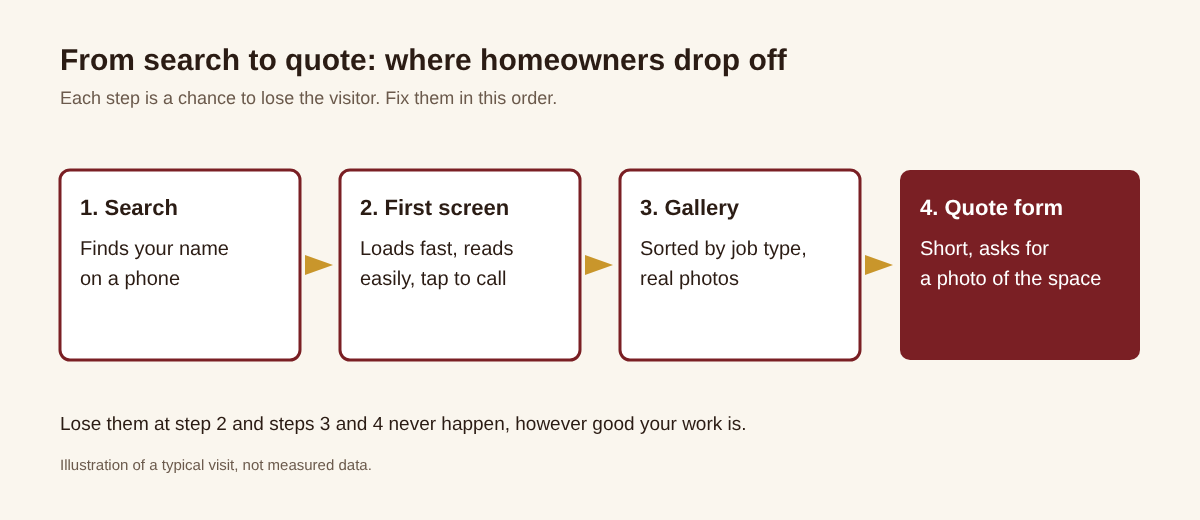
Short version: good contractor website design isn’t about looking fancy. It’s about getting a stranger on a phone from “who is this?” to “send me a quote” before they tap the back button.
Contractor website design wins or loses jobs before you ever pick up the phone. A homeowner who saw your truck or got your name from a neighbor will look you up first. If your site is slow, hard to read on a phone, or hides your work, they move to the next name on the list. You never find out they were there.
The fix isn’t a bigger site. It’s a smaller one that does four jobs well. It shows your work, loads fast on a phone, tells Google what you do, and makes asking for a quote easy.
Your photos are the sales pitch, so sort them
Picture a homeowner planning a shower remodel. She lands on your site and finds forty photos in one long scroll: a deck, a garage floor, a kitchen, two bathrooms. The shower she wanted to see is in there somewhere. She won’t dig for it.
Sorting the gallery by job type fixes that. SmallBiz Marketing, a small agency that builds sites only for tile setters, remodelers, flooring crews and other trades, groups its clients’ work into showers, heated floors, backsplashes and large-format tile. A visitor sees the exact job she’s planning in one tap. It’s a simple idea, and plenty of contractor sites still skip it.
Use your own photos, taken in good light after cleanup. Stock pictures of smiling models in hard hats tell a homeowner nothing about your grout lines.
Why the phone version is the real website
Google looks at the mobile version of your site first when it decides how to rank it. Its own guidance on mobile-first indexing says the content on the phone version is what gets indexed. So if your project pages only show up on a desktop, Google may barely count them.
Google’s Search Central team explains the idea in this short video:
Now check your own site on your own phone. Does the phone number call when you tap it? Can you read the text without zooming? Do the photos load before you lose patience? If any answer is no, that’s your first job.
Make it easy to read in bright sun
Homeowners check you out in parking lots, on lunch breaks, standing in the room they want redone. Light gray text on white looks elegant on a big office screen. Outdoors on a phone, it almost disappears.
The web’s accessibility standard sets a minimum contrast ratio of 4.5 to 1 for normal text. Treat that as your floor. Your readers aren’t sitting at a desk, and dark text on a light background is what they can actually read.
One page per job, not one page for everything
A “Services” page that lumps tile, flooring, kitchens and decks into one block gives Google very little to match. A page about walk-in shower installation, with your photos and the towns you cover, gives it a clear answer when someone nearby searches for exactly that.
Start with the two or three jobs you want more of. You don’t need twenty pages. You need the right five.
Ask for photos before you drive out
Here’s a cheap win most sites miss. Put a short quote form on every page, and ask for a photo of the space plus rough sizes. You’ll spot the job that’s too small, too far away or not your trade before you spend an hour in the truck.
Keep the form short: name, phone, town, what they want done, a photo. Every extra box costs you a few people who would have pressed send.
What a contractor website should cost
Prices vary a lot, so here’s a sense of scale. Trade specialists list starting prices around $2,495 for a fast five-page site with a gallery and a quote form. Adding Google Maps setup and matching business listings brings it to about $3,495. Your domain, platform fees and any ad spend are extra, so ask about those before you sign.
Ask how long it takes, too. A small site shouldn’t take months. Some builders aim for about five days once they have your photos and details. If you’re still weighing a template against a custom build, this piece on why custom website design matters walks through the trade-offs.
The site that gets the call
Your work is already good. The website just has to get out of its way. Sort the photos, check the site on your phone in daylight, give each job its own page, and make the quote form ask the right questions. Do that, and a stranger can go from “who is this?” to “can you come Tuesday?” in one visit.